
Last updated:
As an Amazon Associate I earn from qualifying purchases.
Why a 4K Action Camera Matters on the Trail
If you’ve ever tried to capture a sunrise over a ridge with a phone, you know the frustration of grainy, low‑resolution clips. A 4K action camera solves that problem by delivering the detail you need to relive every ripple on the river or every gust of wind through the pines. For campers, the difference isn’t just aesthetic; it’s about preserving memories that can later be shared in full‑HD on a TV or edited into a short film.
First Impressions of the AKASO EK7000
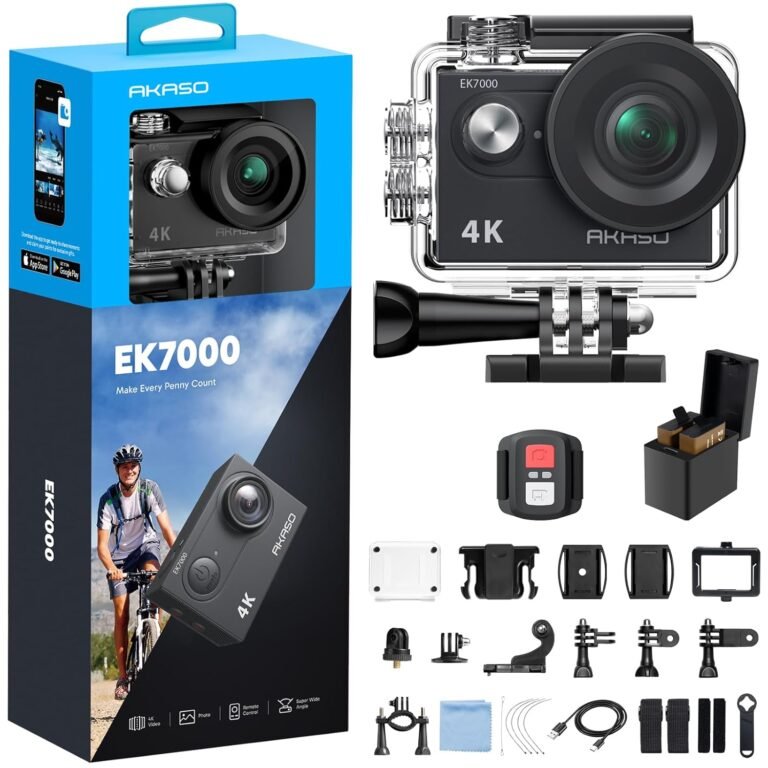
Out of the box, the EK7000 feels like a piece of outdoor gear rather than a piece of tech. The matte black shell resists fingerprints, and the mounting system clicks into place with a reassuring snap. The included silicone case is thick enough to survive a tumble off a rocky ledge, yet flexible enough to slip onto a bike handlebar without adding bulk.
Design that Stands Up to Nature
- Rugged housing – Certified IP68 waterproof, meaning you can submerge it up to 30 meters without a separate case.
- Compact dimensions – Roughly the size of a matchbox, so it slides easily into a pocket or a carabiner.
- Easy‑access buttons – One‑click power, a mode selector, and a shutter button that you can operate with gloved hands.
Ease of Use on the Go
The menu system is navigated with a tiny joystick that feels solid despite its size. You can switch between 1080p @ 60 fps and 4K @ 30 fps without digging through submenus, and the built‑in Wi‑Fi lets you pair the camera with your phone for instant playback.
Image Quality in Real‑World Camping Situations
We tested the EK7000 on three typical camping scenarios: a sunrise hike, a fast‑flowing river, and a night‑time campfire. Here’s what we saw.
Sunrise Hike – Color and Dynamic Range
When the first light hit the peaks, the camera captured the subtle gradations of orange and purple without clipping the highlights. The built‑in HDR mode (when enabled) blended multiple exposures to retain detail in both the sky and the foreground rocks.
River Run – Stabilization and Low‑Light Performance
On a 20‑second descent down a rapid, the EK7000’s electronic image stabilization (EIS) kept the footage steady enough that you could follow the water’s path without a wobble. In low‑light (under a canopy), the sensor held up, producing clean footage at 1080p @ 60 fps; 4K at that light level introduced a modest amount of noise, which is expected for a camera of this size.
Campfire Night – Night Vision Capabilities
Using the built‑in night mode, the camera recorded the flickering flames with enough detail to see the sparks. While the resolution dropped to 720p, the footage remained usable for a quick highlight reel. Adding a small LED light to the mount helped boost exposure without washing out the scene.
Battery Life and Power Management
In the field, you’ll likely be charging the camera at the campsite rather than carrying spare packs. The EK7000’s 1050 mAh battery delivered roughly 90 minutes of continuous 4K recording on a full charge. Switching to 1080p extended runtime to about 2 hours. The camera also offers a power‑saving mode that shuts off the LCD when not in use, which can stretch the battery for quick photo bursts.
Storage Options and File Management
The EK7000 supports microSD cards up to 128 GB. We recommend a Class 10 UHS‑I card for reliable 4K performance. The camera automatically creates folders by date, making it easy to locate footage after a multi‑day trek. Transfer is done via USB‑C, and the companion app lets you trim clips directly on your phone—a handy feature when you want to share a highlight on social media without a laptop.
Mounting Flexibility for Every Adventure
Camping often means improvisation: a helmet for a mountain bike ride, a chest strap for a paddle‑boarding session, or a tripod for a time‑lapse of the night sky. The EK7000’s universal 1‑inch screw works with most aftermarket mounts, and the kit includes a helmet mount, a suction cup, and a flexible tripod. The ability to attach the camera to a kayak paddle or a hiking pole expands your storytelling toolbox dramatically.
Comparing the EK7000 to Other 4K Action Cameras
While we’re focusing on the EK7000, it helps to understand how it stacks up against the broader market.
- Resolution – 4K @ 30 fps is now a baseline; higher‑end models may offer 4K @ 60 fps, but they often sacrifice battery life or add bulk.
- Stabilization – The EK7000’s EIS is solid for most outdoor activities; optical stabilization (found in pricier units) can smooth out extreme motion like downhill mountain biking.
- Waterproofing – Built‑in IP68 means you won’t need an extra case for most water sports. Some competitors require a separate housing for deep dives.
- Price‑to‑Performance Ratio – The EK7000 lands in the budget‑friendly tier while still delivering true 4K video, making it a sweet spot for campers who want quality without breaking the bank.
Practical Tips for Getting the Most Out of Your Camera on Camping Trips
- Plan your shots before you leave – Sketch a quick shot list (sunrise, trail overview, campfire) so you know which settings to pre‑set.
- Use a protective case for extreme conditions – Even IP68 cameras benefit from an extra silicone sleeve when you’re dealing with sand or heavy debris.
- Keep spare batteries warm – In cold weather, store spares in an inner pocket close to your body to preserve charge.
- Leverage Wi‑Fi for quick backups – At the end of the day, connect to your phone and upload key clips; this prevents data loss if the card gets damaged.
- Experiment with mounting angles – A low‑angle mount on a rock can make a river look more dramatic; a high‑angle helmet mount gives a rider’s perspective.
When to Upgrade: Signs It’s Time for a New Camera Type
Even the best 4K action camera will eventually feel limited. Consider switching to one of these broader categories if you notice any of the following:
- Desire for true 4K @ 60 fps to capture fast action with smoother motion.
- Need for advanced optical image stabilization for high‑speed sports.
- Longer battery life for multi‑day treks without access to power.
- Professional‑grade low‑light performance for astrophotography.
If any of those resonate, you might explore these product types:
- high‑performance 4K action camera
- compact 360‑degree camera
- action camera with optical stabilization
- long‑life battery action camera
Final Verdict: Is the AKASO EK7000 the Right Choice for Campers?
For the majority of outdoor enthusiasts, the AKASO EK7000 hits the sweet spot of durability, image quality, and price. It records crisp 4K video, survives submersion, and offers a mounting ecosystem that adapts to nearly any campsite scenario. Its battery life is sufficient for day trips, and the app makes quick sharing a breeze. If you’re a casual camper who wants to document hikes, river runs, and campfire stories without hauling a DSLR, this camera is a solid match.
FAQ
Can the EK7000 record underwater without an extra case?
Yes. Its IP68 rating lets you submerge the camera up to 30 meters straight out of the box, making it suitable for snorkeling or river shots.
What type of memory card should I use for 4K recording?
A Class 10 UHS‑I microSD card of at least 64 GB is recommended. Faster cards reduce the risk of dropped frames during high‑resolution capture.
Is the camera’s Wi‑Fi secure for transferring footage?
The EK7000 uses a password‑protected connection via its companion app, so only devices you authorize can access the camera’s files.
Take the Next Step
Ready to capture your next adventure in true 4K? Grab an EK7000, pair it with a reliable microSD card, and start planning those cinematic trail shots. And remember: the best footage isn’t just about the gear—it’s about the stories you tell. Happy camping, and may your videos be as unforgettable as the wilderness itself.
Also read: Best Action Camera Deals: 7 Costly Mistakes to Avoid